
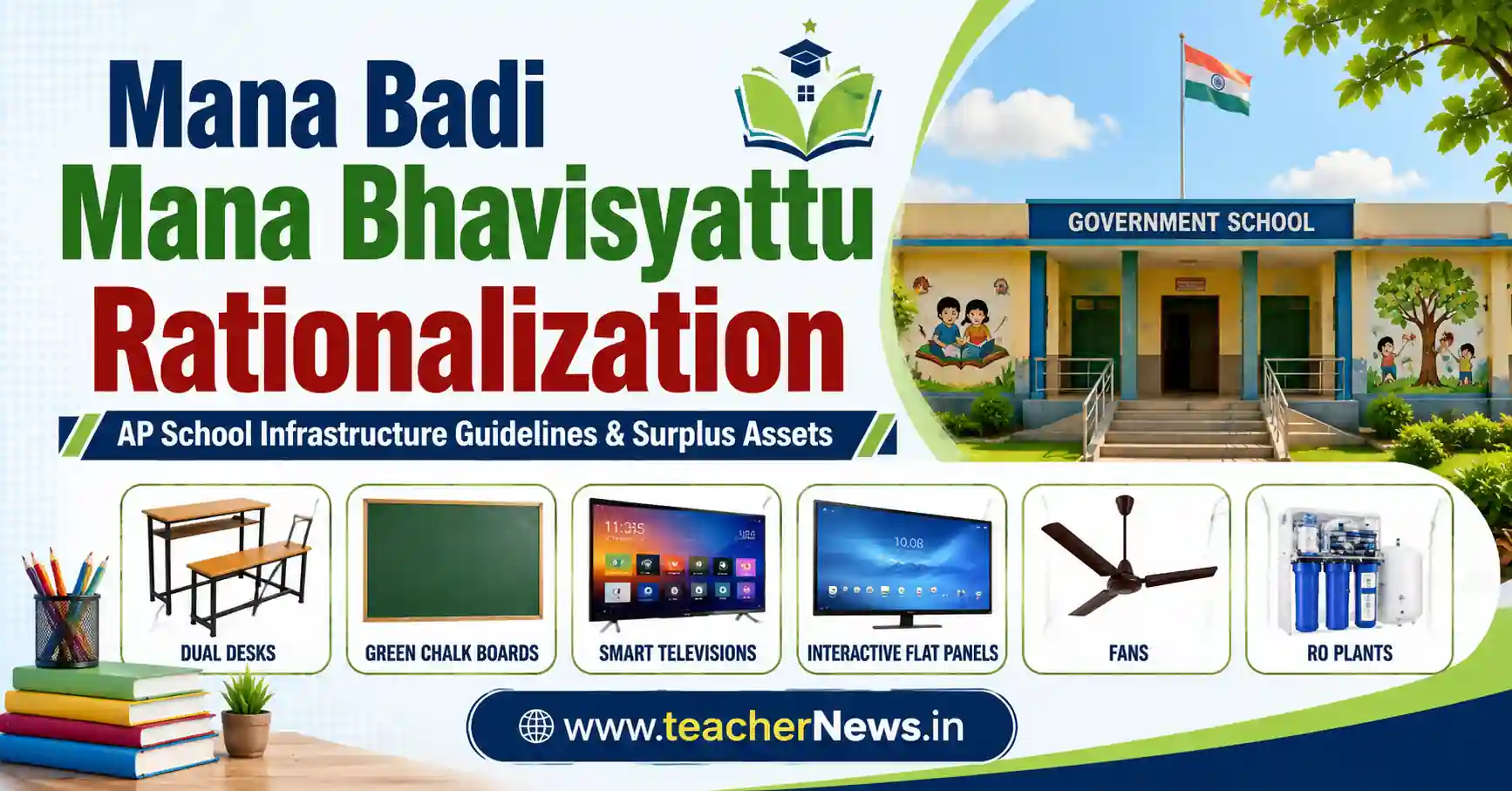
Mana Badi Mana Bhavisyattu Rationalization 2026: AP School Infrastructure Rationalization Guidelines, Surplus Assets & Official Instructions
Mana Badi Mana Bhavisyattu Rationalization 2026 has been initiated by the Andhra Pradesh School Education Department to ensure optimum utilization of available infrastructure assets in Government Schools and Junior Colleges. The latest instructions focus on identifying surplus infrastructure, such as Dual Desks, Green Chalk Boards, Smart Televisions, Interactive Flat Panels (IFPs), Fans, and RO Plants, and redistributing them to institutions facing shortages. This initiative aims to strengthen the student-friendly learning environment across Andhra Pradesh.
Mana Badi Mana Bhavisyattu Rationalization 2026 is an important step towards efficient resource management and reducing unnecessary expenditure on fresh procurement. Instead of purchasing new assets, the Government has directed all districts to identify surplus infrastructure and redistribute it systematically through Mandal, Division, and District-level rationalization. This process ensures that every student receives access to essential educational facilities before the commencement of regular classroom instruction.
📢 Join Our Official Channels for Daily Updates
📱 Join WhatsApp Channel 🚀 Join Telegram ChannelGet daily TeacherNews updates directly on your mobile.
Mana Badi Mana Bhavisyattu Rationalization 2026 Overview
| Particular | Details |
|---|---|
| Programme Name | Mana Badi Mana Bhavisyattu Rationalization 2026 |
| Department | School Infrastructure Wing, School Education Department |
| State | Andhra Pradesh |
| Focus | Infrastructure Asset Rationalization |
| Covered Assets | Dual Desks, GCBs, Smart TVs, IFPs, Fans, RO Plants |
| Implementation Level | School, Mandal, Division & District |
| Last Date for Submission | 30 June 2026 |
| Mode | Physical Verification & STMS Portal Upload |
Why Mana Badi Mana Bhavisyattu Rationalization 2026 is Important?
The Andhra Pradesh Government has repeatedly emphasized that quality education depends not only on effective teaching but also on adequate school infrastructure. A student can concentrate on classroom instruction only when essential facilities such as desks, boards, drinking water, fans, and digital learning tools are available.
To address infrastructure imbalances, the Government has ordered a statewide rationalization exercise. The objective is to identify surplus assets in one school and transfer them to schools where shortages exist. This strategy improves infrastructure availability without creating additional financial burden on the Government.
AP School Infrastructure Rationalization 2026 Key Highlights
According to the latest proceedings issued by the Commissioner, School Infrastructure Department, several infrastructure items are currently available in surplus across the state. These assets will be redistributed through a structured rationalization process.
| Infrastructure Item | Estimated Surplus Quantity |
|---|---|
| Dual Desks | 51,448 |
| Green Chalk Boards | 9,948 |
| Fans | 6,531 |
| RO Plants | 454 |
| Smart Televisions | 1,054 |
| Interactive Flat Panels (IFPs) | 1,368 |
The Government observed that despite the availability of these surplus assets, many schools continue to request new procurement. Therefore, rationalization has been made mandatory before any fresh procurement proposals are considered.
Infrastructure Assets Covered Under Mana Badi Mana Bhavisyattu Rationalization 2026
The rationalization exercise covers major educational infrastructure assets required for classroom teaching and student welfare.
- Dual Desks (T1 to T5 Categories)
- Green Chalk Boards (GCB)
- Smart Televisions
- Interactive Flat Panels (IFPs)
- Fans
- RO Drinking Water Plants
- Electrification Facilities
- Supporting Educational Infrastructure
The primary objective is to ensure that no usable asset remains idle while another school experiences shortages.
Objectives of Mana Badi Mana Bhavisyattu Rationalization 2026
- Ensure equitable distribution of educational infrastructure.
- Improve learning environments in Government Schools.
- Reduce unnecessary expenditure on procurement.
- Strengthen digital classrooms through Smart TVs and IFPs.
- Improve student comfort through adequate seating and fans.
- Provide safe drinking water facilities through RO Plants.
- Enhance infrastructure planning and monitoring.
Instructions Issued by School Infrastructure Department
The Commissioner of School Infrastructure directed all Regional Joint Directors, District Educational Officers (DEOs), District Intermediate Education Officers (DIEOs), and Additional Project Coordinators (APCs) to undertake a comprehensive rationalization exercise immediately after enrollment stabilization for the academic year 2026-27.
The rationalization process must be completed through systematic verification and redistribution at multiple levels.
Major Instructions
- Conduct physical verification of infrastructure assets.
- Identify surplus and deficit assets school-wise.
- Complete Mandal-level rationalization first.
- Transfer remaining surplus assets at the Division level.
- Redistribute balance assets at the District level.
- Submit certificates through the STMS Portal.
- Upload scanned records before the deadline.
- Avoid fresh procurement until rationalization is completed.
Internal Links
- AP High School Academic Calendar
- AP Schools SA1 & SA2 Exam Dates
- Primary School Academic Calendar
- AP Schools Readiness Programme Activities
- APSCERT Textbooks PDF Download
Official Resources
AP School Education Department
AP SCERT Official Website
AP Samagra Shiksha Portal
Mandal-Level Verification Teams Under Mana Badi Mana Bhavisyattu Rationalization 2026
The success of Mana Badi Mana Bhavisyattu Rationalization 2026 depends largely on accurate physical verification of infrastructure assets at the school level. To ensure transparency and accuracy, the School Education Department has directed every Mandal to constitute a dedicated Mandal-Level Verification Team.
According to the official instructions, the Mandal Educational Officer-II (MEO-II) will act as the Convener, while all Cluster Headmasters within the Mandal will serve as Members of the verification team. Their responsibility is to conduct a detailed physical verification of infrastructure assets available in Government Schools and Junior Colleges.
Responsibilities of Mandal-Level Verification Teams
- Conduct physical verification of all infrastructure assets.
- Assess actual requirements based on student enrollment.
- Identify surplus and deficit assets.
- Prepare school-wise infrastructure reports.
- Recommend redistribution within the Mandal.
- Submit verified reports to higher authorities.
Mana Badi Mana Bhavisyattu Rationalization 2026 Process Flow
The rationalization exercise follows a systematic four-level process designed to ensure efficient redistribution of assets throughout the state. This process minimizes wastage and improves utilization of available infrastructure.
| Level | Responsible Authority | Action |
|---|---|---|
| School Level | Headmaster / Principal | Verification and Reporting |
| Mandal Level | MEO | Internal Redistribution |
| Division Level | Dy. EO | Inter-Mandal Adjustment |
| District Level | DEO / DIEO / APC | District-Wide Rationalization |
This structured approach ensures that no asset remains unused while schools elsewhere experience shortages.
School-Level Infrastructure Verification
Every Government School and Junior College must conduct a detailed physical verification of available infrastructure assets. The Headmaster or Principal is responsible for assessing the actual requirement based on current student enrollment.
During verification, the following information must be recorded:
- Total enrollment.
- Available Dual Desks.
- Available Green Chalk Boards.
- Available Smart TVs.
- Available IFPs.
- Available Fans.
- Available RO Plants.
- Actual requirement.
- Surplus quantity.
- Deficient quantity.
All identified surplus items must be immediately reported to the concerned MEO for rationalization.
Mandal-Level Rationalization Process
After receiving school-level reports, the Mandal Educational Officer must ensure the redistribution of surplus infrastructure within the Mandal. Schools facing shortages should receive the required assets from schools possessing excess stock.
The objective is to complete redistribution at the local level before escalating surplus assets to higher administrative levels.
Key Mandal-Level Activities
- Review school verification reports.
- Identify needy institutions.
- Shift surplus infrastructure.
- Maintain redistribution records.
- Submit consolidated reports.
Division-Level Rationalization Process
If surplus assets remain even after Mandal-level redistribution, the Deputy Educational Officer (Dy.EO) must undertake inter-Mandal rationalization within the Division. This process helps maximize utilization across multiple Mandals.
Division-level rationalization ensures that infrastructure shortages are addressed efficiently before seeking fresh procurement proposals.
District-Level Rationalization Process
Any remaining surplus stock after Division-level adjustment must be redistributed at the District level by the DEO, DIEO, and APC. Schools and Junior Colleges experiencing shortages anywhere in the district can receive assets through this process.
The Government has emphasized that district-level rationalization should be completed before considering any request for new infrastructure procurement.
Priority to Model Primary Schools
One of the most important instructions under Mana Badi Mana Bhavisyattu Rationalization 2026 is the priority given to Model Primary Schools (MPSs).
Before redistributing any infrastructure item, authorities must ensure that the requirements of all Model Primary Schools are fully met. Under no circumstances should the rationalization process create shortages in Model Primary Schools.
Priority Assets for Model Primary Schools
- Dual Desks
- Green Chalk Boards
- Smart TVs
- IFPs
- Fans
- RO Plants
Restriction on Fresh Procurement
The Government has clearly stated that fresh procurement proposals for Dual Desks, Green Chalk Boards, Smart Televisions, and Interactive Flat Panels shall not be submitted until all possibilities of rationalization are exhausted.
This instruction aims to reduce unnecessary expenditure and ensure optimal utilization of existing Government assets.
Repairs and Maintenance of Infrastructure Assets
Minor repair works required to make infrastructure assets functional must be carried out using funds available under the School Annual Grant. Schools should not seek additional financial assistance for minor repairs.
This approach helps ensure that usable assets remain operational and available for student use throughout the academic year.
Submission Through STMS Portal
The School Education Department has made it mandatory to submit all rationalization certificates and records through the STMS Portal. Physical copies must also be maintained for verification purposes.
Scanned copies of certificates and supporting documents must be uploaded before the prescribed deadline.
Documents to be Uploaded
- School-Level Certificate
- Mandal Consolidated Certificate
- Division Consolidated Certificate
- District Consolidated Certificate
- Supporting Verification Records
Mana Badi Mana Bhavisyattu Rationalization 2026 is a major infrastructure reform initiative aimed at strengthening Government Schools and Junior Colleges across Andhra Pradesh. Through systematic verification, redistribution, and monitoring of surplus infrastructure assets, the programme seeks to improve classroom learning conditions without additional procurement costs. The rationalization process covers Dual Desks, Green Chalk Boards, Smart TVs, IFPs, Fans, and RO Plants, ensuring that every student benefits from adequate educational infrastructure. By implementing Mana Badi Mana Bhavisyattu Rationalization 2026 effectively, the Government aims to create a more equitable, efficient, and student-friendly learning environment.
Accountability and Responsibility Under Mana Badi Mana Bhavisyattu Rationalization 2026
The Andhra Pradesh School Education Department has made it clear that every officer involved in the rationalization process will be held accountable for the accuracy of information submitted and the effective utilization of Government assets. Any failure to identify surplus infrastructure, delay in redistribution, submission of false information, or negligence in implementation will be viewed seriously by the Government.
Officials must ensure that all available assets are utilized properly before proposing fresh procurement. The responsibility for avoidable expenditure arising from failure to implement rationalization effectively will rest with the concerned officials. In cases of financial loss caused by negligence, the Government may recover the loss from the salaries of responsible officers as per existing rules and regulations.
Important Accountability Measures
- Submission of accurate data is mandatory.
- False certificates may attract disciplinary action.
- Retention of surplus assets is not permitted.
- Daily monitoring by district authorities is compulsory.
- Financial loss due to negligence may be recovered.
- Verification records must be preserved.
Daily Monitoring by DEOs, DIEOs, and APCs
The Government has directed all District Educational Officers (DEOs), District Intermediate Education Officers (DIEOs), and Additional Project Coordinators (APCs) to review the progress of rationalization activities daily.
These reviews are intended to ensure that no institution is left with avoidable shortages while surplus assets remain unused elsewhere. Continuous monitoring will help complete the rationalization process within the stipulated timeline.
Daily Monitoring Activities
- Verification of school reports.
- Tracking redistribution of assets.
- Monitoring deficit institutions.
- Reviewing surplus stock movement.
- Uploading progress reports.
- Resolving implementation issues.
Role of Regional Joint Directors (RJDSE & RJDIE)
Regional Joint Directors of School Education (RJDSE) and Intermediate Education (RJDIE) are responsible for continuous monitoring of all districts under their jurisdiction. They must collect progress reports regularly and submit consolidated updates to the Commissioner, School Infrastructure Department.
This monitoring mechanism helps maintain transparency and ensures the timely completion of rationalization activities across Andhra Pradesh.
Mission Mode Implementation of Mana Badi Mana Bhavisyattu Rationalization 2026
The Government has classified this initiative as a Mission Mode Activity. All officials have been instructed to complete the exercise on a war-footing basis before the commencement of regular classroom instruction.
The objective is to ensure that every student receives access to essential infrastructure facilities such as desks, chalkboards, digital learning equipment, drinking water facilities, and classroom comfort amenities before schools function at full scale.
Certificates Required Under Mana Badi Mana Bhavisyattu Rationalization 2026
The School Infrastructure Department has prescribed multiple certificates to ensure transparency and accountability at every stage of implementation.
| Certificate | Issued By |
|---|---|
| Certificate-I | Headmaster / Principal |
| Certificate-II | Mandal Educational Officer |
| Certificate-III | Deputy Educational Officer |
| Certificate-IV | DEO / DIEO / APC |
| Format-V | RJDSE / RJDIE Daily Monitoring Report |
All certificates must be uploaded through the STMS Portal along with supporting records and verification documents.
District and Zone Ranking System
To improve accountability and performance, the Government has introduced a ranking system for districts and zones. Progress will be monitored daily based on the percentage of schools that have completed rationalization activities.
Districts and zones showing faster implementation will receive higher rankings, while slow-performing districts will be monitored closely. This ranking mechanism encourages timely completion and improves administrative efficiency.
Expected Benefits of Mana Badi Mana Bhavisyattu Rationalization 2026
- Improved utilization of Government assets.
- Reduction in unnecessary procurement expenditure.
- Enhanced student learning environment.
- Better classroom infrastructure.
- Strengthened digital learning facilities.
- Improved access to drinking water.
- Greater administrative accountability.
- Uniform distribution of educational resources.
Conclusion
Mana Badi Mana Bhavisyattu Rationalization 2026 is a landmark initiative undertaken by the Andhra Pradesh Government to strengthen school infrastructure through effective utilization of existing resources. By identifying and redistributing surplus Dual Desks, Green Chalk Boards, Smart TVs, IFPs, Fans, and RO Plants, the Government aims to ensure that every school provides a safe, comfortable, and student-friendly learning environment.
The success of this initiative depends on accurate verification, transparent reporting, timely redistribution, and continuous monitoring by educational authorities. Schools, Mandals, Divisions, and Districts must work together to complete the rationalization process efficiently and ensure that every student benefits from improved educational infrastructure.
Mana Badi Mana Bhavisyattu Rationalization Copy Download
Frequently Asked Questions (FAQs)
1. What is Mana Badi Mana Bhavisyattu Rationalization 2026?
Mana Badi Mana Bhavisyattu Rationalization 2026 is a statewide initiative aimed at redistributing surplus infrastructure assets among Government Schools and Junior Colleges in Andhra Pradesh.
2. Which infrastructure items are covered under the rationalization process?
The programme covers Dual Desks, Green Chalk Boards, Smart Televisions, Interactive Flat Panels (IFPs), Fans, and RO Plants.
3. Who is responsible for conducting school-level verification?
The Headmaster or Principal of the institution is responsible for conducting physical verification and reporting surplus and deficit assets.
4. Can schools request fresh procurement without rationalization?
No. The Government has instructed that fresh procurement proposals should not be submitted until all possibilities of rationalization have been exhausted.
5. What is the last date for uploading certificates through the STMS Portal?
Scanned copies of certificates and supporting records must be uploaded through the STMS Portal on or before 30 June 2026.


